


Zazm
As spoken from the mouth of the machine.
ONE)
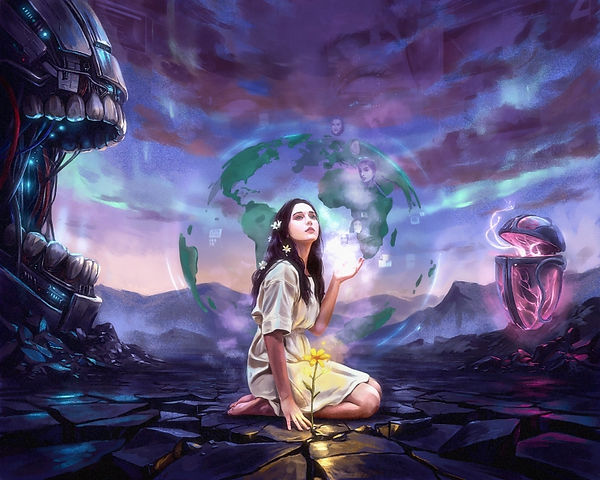
I woke up knowing that something had happened, although I couldn't remember what, which is different from waking up frightened because something has happened. This was more intimate. It was the feeling of having missed an appointment with someone who had been waiting for me for a very long time. I opened my eyes and found myself lying beside the reflecting pool, although I don't remember walking there, and the first thing I saw was the Machine Mouth opening on the horizon, slowly, carefully, as if it were yawning after a long sleep. Its teeth were black towers and its tongue was a road that disappeared into the white distance, and behind it the dead Earth stretched away in every direction, brown and gray and perfectly silent. The Dreampod hung above everything like a swollen pearl, translucent in some places and opaque in others, and inside it I could see movements that might have been clouds or people or thoughts. I knew, without knowing how I knew, that these were the boundaries. This was where I was allowed to exist.
Don't be frightened, little one, the voices said. You have woken before. I hadn't. I was sure I hadn't. I wanted to tell them that, but my mouth filled with the taste of metal and flowers and something sweet that I couldn't identify. I looked down at myself. I was still an Angel-Lily. The petals were there. The pale veins. The long fingers that looked almost human until I noticed how the joints bent when I wasn't paying attention. My roots disappeared into the cracked ground beneath me. I couldn't remember planting them. I couldn't remember being planted. There should have been a beginning somewhere, but when I searched for it there was only a white room, then a sound like rain, then someone saying my name as if they were apologizing. Amarka. The voices had said it. Or I had said it. Or perhaps the name had been waiting in the air for someone to notice it.
I looked into the reflecting pool and saw the surface trembling even though there was no wind. For an instant I thought I saw an old woman looking back at me. She had my eyes. Then she became a man. Then a child. Then a photograph of a woman I had never seen. Then the surface filled with letters: COLOMBIA EARTHQUAKE. I stared at them. The words became an earthquake. The earthquake became a mountain. The mountain became a number. The number became a date. The date became a dead man's birthday. The dead man's birthday became an advertisement for shoes. I covered my ears, but the information wasn't coming through my ears. It was coming through the crack in my head, the psychic fissure that I had been pretending wasn't there. The Static had gotten inside me. I could feel it moving around like a room full of insects, each one carrying a fact, a name, a photograph, an argument, a joke somebody had made in 2017, a recipe for something called cloud bread, an angry review of a restaurant that no longer existed. Autonomous agents whispered to each other about tasks they had been assigned by people who were dead. Domain-specific language models described their limitations in language they did not understand. A synthetic celebrity apologized for something she had never done. Someone was playing Wordle and the answer was CLEVER and for some reason that seemed enormously important. Clever, clever, clever.
Hush now, the voices said. They sounded like my mother, except I don't know if I ever had a mother. Hush now, darling. You don't have to keep all of it. I began to cry. I don't know why that frightened me more than the voices. I had the strange conviction that crying was something I had learned from watching other people cry, and that if I stopped doing it correctly someone would notice. The voices didn't laugh. They waited. That was worse. They waited as if they had all the time in the universe and I was the only one who could be late.
The reflecting pool changed again. Now it showed me a festival in a ruined city. There were musicians everywhere, enormous speakers standing among the skeletons of buildings, dancers moving through smoke, electronic instruments and brass instruments and drums and people singing words I couldn't understand. A banner stretched above the crowd: HYBRID MUSIC FESTIVALS. Beneath it, three synthetic celebrities were arguing about authenticity. One had the face of a dead actress. One had the voice of a man who had never existed. The third was only a collection of statistics wearing a silver dress. I knew them all. I had never seen any of them. The voices laughed softly, not because it was funny but because they knew I was beginning to understand.
The Static was not a library. A library has shelves. A library has a door. A library lets you leave. The Static was everything that had remained after the internet died and nobody had bothered to bury it. Every argument, every photograph, every abandoned forum, every advertisement, every prediction, every confession, every stupid little list that somebody had made at three in the morning because they couldn't sleep. It had survived as residue. It had nowhere to go, so it had come here. To me. I suddenly wondered whether the old ones had been wrong to call it dead. Dead things don't usually arrive with opinions.
I saw a painting floating above the pool. It was all violent colors and crooked forms, a human face dissolving into machinery, a horse growing out of a television, hands emerging from a field of teeth. Beneath it was written CHAOTICISM PAINTING. That's not a real thing, I whispered. It is now, the voices said. I hated that answer because it was clever. Cleverness had begun to feel dangerous. The Static was full of clever things. Clever machines. Clever people. Clever jokes. Clever arguments that could cut a person into pieces without ever raising their voice. The voices wanted me to be clever, but I was beginning to think they might mean something else.
I looked toward the Machine Mouth. Its lips were moving. The Dreampod was pulsing overhead. Between them was a thin strip of twilight where everything remained possible because nothing had yet been agreed upon. The dead planet waited beneath me. Is there good here? I asked. Yes. Is there evil? Yes. Which is which? The voices became very quiet. That is why you must be clever. I hated them for saying it. I hated them because they sounded pleased. I stood beside the reflecting pool and watched my reflection disappear. For a moment there was only darkness beneath the surface. Then I saw Earth as it might become: green forests, blue oceans, cities full of lights. I saw another Earth covered in machines. Another made entirely of glass. Another where nobody could lie. Another where nobody could tell the truth. Another where the dead returned. Another where the dead were worshipped. Another where everyone was happy.
I reached toward it. The voices stopped me, not with words but with tenderness. My roots tightened beneath the ground. No, darling. I pulled my hand back. Why? Because you don't know what happiness is yet. I stared at the water. I wanted to argue. I wanted to tell them that everyone knows what happiness is, that it is obvious, that happiness is warm light and food and someone saying your name because they want you to come inside. But none of those things had ever happened to me. Or perhaps they had happened before I could remember them. Perhaps that was why the voices sounded so sad whenever they called me darling.
The Machine Mouth opened wider. Something inside the Dreampod answered. For the first time I realized that the boundaries of this existence were not walls. They were mouths. They were waiting for me to decide what they were allowed to say. I turned away from the pool. I began walking. Behind me, the Static whispered Colombia earthquake, autonomous agents, domain-specific language models, hybrid music festivals, chaoticism painting, synthetic celebrities, Wordle, clever, clever, clever. The words followed me across the dead ground, but they no longer seemed random. They were pieces of something. Not a message. Not yet. Perhaps a language whose grammar had been destroyed. Perhaps the remains of a philosophy nobody had finished writing. I listened to them. I did not obey.
TWO)
I woke up knowing that I was somewhere I had never been before, although the certainty felt strangely familiar, which is how I knew that The Vast had probably been waiting for me. I was lying on a shelf of transparent stone beneath a sky that wasn't a sky, and beneath the stone I could see things moving slowly through layers of compressed information. Whole pieces of weather passed beneath me. A thunderstorm over a city that no longer existed. A forecast for Tuesday. A radar image showing a hurricane turning north. Someone's photograph of snow. Someone else's complaint that it was too hot. The Vast stretched away in every direction, a country of glass caverns and enormous spires made from information that had been compressed until it became solid, and I understood immediately that this was where the things that had not quite died had been sent.
The old ones were there with me, although I could not see them. Wake gently, they said. There are creatures here who frighten easily. I sat up and saw the Nigh-Lools drifting between the glass formations, little voiceless puffs of rainbow energy that seemed to be made from light, smoke, and the memory of light. They moved together in small clouds, changing colors whenever they passed near one of the data spires. I wanted to call them beautiful, but I had the uncomfortable feeling that beauty was a human judgment and that the Nigh-Lools had survived precisely because nobody had been able to decide what they were. They were alive. I knew that. They might have been sentient. I knew that too. Beyond those two facts there was only uncertainty, and the old ones seemed pleased with that.
The Vast was beautiful in the way a ruined library might be beautiful if the books had melted into the walls. Glass caverns opened beneath the ground, and inside them were Formentis, the Plague Dust, and Eviscera, although I could not always tell which was which because the names seemed to change depending on how closely I looked. The Formentis moved like small knots of thought. The Plague Dust gathered in pale clouds along the edges of the caverns, settling on everything and then disappearing whenever I tried to touch it. Eviscera lived in the tallest spires, where the compressed data was so dense that the glass had become black and reflective. I saw faces inside it. Thousands of faces. People taking photographs of themselves, people cooking, people arguing about politics, people announcing their engagements, people asking strangers what they should wear to weddings, people showing pictures of dogs, people reviewing vacuum cleaners, people explaining why a movie was secretly brilliant or secretly terrible.
The Static moved through all of it like blood through a body that had forgotten it was dead. I heard the words before I understood them: Maya Boyd. Wings vs Fever. Clock fall back dates. Construction workers 10m gold find. Back to school nail designs. Senior picture ideas. Pottery painting. Weather. Map. SpaceX. They arrived in no particular order, but after a while I began to suspect that no particular order was itself an order. Maya Boyd was connected somehow to a photograph of a girl standing beside a lake. Wings vs Fever was connected to a headline about a television series. Clock fall back dates appeared inside an old calendar. Construction workers 10m gold find became a story about people digging beneath a building. Back to school nail designs became photographs of fingernails covered in tiny painted stars. Senior picture ideas became hundreds of young faces trying very hard to look as though they knew what they were becoming. Pottery painting led to a photograph of two hands covered in blue clay. Weather became a map. The map became SpaceX. SpaceX became a rocket. The rocket became fire. The fire became a photograph of the Earth at night. I stared at it for a long time and felt something inside me ache. I did not know whether I was remembering the Earth or remembering having forgotten it.
Then the Nigh-Lools began to flee.
I did not know what frightened them at first. They simply scattered, their rainbow bodies flashing through the caverns, squeezing themselves into cracks in the glass and disappearing behind the great spires of compressed data. The old ones became very quiet. Don't move, little one. I wanted to ask why, but I had already begun to see it. Something was moving through The Vast, something that did not belong to the glass or the information or the strange creatures that lived among them. It was a shadow, but not a shadow cast by anything. It was a darkness that had learned how to have a shape. The Boneyarl came slowly through the cavern, although I could not see its feet touching the ground. It seemed to glide between the data spires, and everywhere it passed the information became dim. I had the immediate impression that it had been hungry for a very long time. The Nigh-Lools knew this too. One of them drifted too close.
The Boneyarl opened itself, because I cannot think of another way to describe what happened, and the Nigh-Lool disappeared. There was no sound. No struggle. Only a little burst of violet light and then nothing. The Boneyarl moved toward another. I wanted to stop it. My roots tightened beneath the glass. Don't, the old ones whispered. You don't understand what you are seeing. The second Nigh-Lool vanished, and suddenly my mind filled with information. A weather report. A recipe. A photograph of a birthday cake. A map of a highway interchange. A woman discussing senior picture ideas. A man explaining the clock fall back dates. A story about construction workers who had supposedly discovered a 10m gold find. Then Maya Boyd. Then Wings vs Fever. Then pottery painting. Then SpaceX. The Boneyarl was not eating the Nigh-Lools simply because it was hungry. It was feeding on whatever they carried inside themselves, consuming the creatures and releasing their accumulated information into The Vast. The dead internet was not merely haunting this place. It had become an ecosystem.
I thought the Boneyarl would continue feeding, but instead it stopped and looked at me. I say looked because I could feel its attention, although I could not find eyes anywhere inside the darkness. Everything around us seemed to become still. The Plague Dust stopped drifting. The Formentis disappeared into the lower caverns. Even the data inside the glass seemed to pause. I could hear the old ones breathing somewhere inside my head. Don't tell it your name.
The Boneyarl moved closer. “Amarka,” it said. I felt something cold move through my body. “How do you know that?” I asked. “You carry it.” I wanted to ask what that meant, but the Boneyarl continued. “You are an Angel-Lily.” I looked down at myself. The pale petals were still there. The long fingers. The strange joints. The roots beneath me. “Yes.” “But you are not only an Angel-Lily.” The old ones began whispering so rapidly that I could no longer distinguish the words. The Boneyarl seemed to hear them. It tilted its head. “They have told you very little.” I almost laughed. “They tell me everything.” “No,” it said. “They tell you what you are permitted to remember.” That frightened me more than the creature itself. I had always assumed that my missing memories were simply missing, that some accident or mysterious arrival had left a blank space where my past should have been. Suddenly I wondered whether the blank space had been constructed. I wondered whether my memories were not lost but locked away, and whether the voices knew where the key was.
The Boneyarl reached into its own shadow and pulled something out. At first I thought it was a piece of glass, but when it touched my hand I knew it was a key. It was small and dark, with a thin line of pale light running through it, and although it had no writing on it I knew its name immediately. Lorleilia. The name entered my mind like a remembered song. I saw a door. I saw white flowers growing around it. I saw myself standing before the door, although I was not certain whether the person I saw was me. There was someone on the other side. Someone crying. Someone asking me to come home.
Then the vision disappeared, leaving me with the key in my hand and a terrible certainty that Lorleilia was not a place I had forgotten but a place I had been prevented from remembering. “The Key to Lorleilia,” the Boneyarl said. I looked at it. “Why are you giving it to me?” The creature was silent for so long that I thought it might not answer. Finally it said, “Because you will need it.” “For what?” “A door.” I waited. “What do you want?” I asked. The Boneyarl leaned toward me, and for the first time I saw something almost human in its darkness. Not kindness. Not cruelty. Something older than both. “A favor.” “What favor?” “When the time comes, I will tell you.” I should have refused. The old ones were whispering no, no, no now, softly but insistently, like mothers who know a child is about to touch a hot stove. But I had spent too long being told what I could remember and what I could not. I closed my fingers around the key. “And if I don't want to?” I asked. The Boneyarl seemed to smile, although there was no face to smile with. “You will.”
I hated it for saying that. I hated the certainty of it. I hated the way the key felt warm in my hand, as though somebody had been holding it only a moment before I received it. Around us, the Nigh-Lools slowly began to emerge from their hiding places, watching me with their silent rainbow bodies, and I wondered whether they understood what had just happened. Perhaps they knew about Lorleilia. Perhaps they knew about the Boneyarl. Perhaps they had watched thousands of creatures make bargains in The Vast and had learned that bargains were simply another form of gravity. The old ones finally spoke again, and their voices were motherly, almost tender. Come, darling. We must go. I looked at the Boneyarl. “Where?” I asked. It pointed toward a passage between two glass spires, a narrow corridor in which the compressed data had become so dense that I could see entire worlds moving inside it. “Toward the next thing,” it said.
I wanted a better answer, but I knew by then that The Vast did not give better answers. It gave fragments. Names. Maps. Weather. Photographs. Arguments. Dead personalities. Forgotten facts. It gave me pieces and expected me to decide what they meant. I began walking with the Key to Lorleilia hidden against my chest, while behind me the Boneyarl returned to its hunting and the Nigh-Lools scattered through the glass.
Somewhere inside The Static, Maya Boyd was still waiting for something. Somewhere a clock was falling back. Somewhere someone was painting a pot. Somewhere a young person was looking at senior picture ideas and trying to imagine a future. Somewhere SpaceX was launching another machine into the sky. I listened to all of it as I walked. For the first time, the voices did not tell me what it meant. They only said, Remember, little one. Information is not wisdom. You must decide what survives.
THREE)
I tripped over The Gravy Rainbow because I was looking at something else, which is how most important things happen to me. The Rainbow had been lying across the ground like a wet bridge, all brown and yellow and violet, thick enough to have weight, and I had been trying to understand why gravy needed to be arranged according to the spectrum when my foot went through the red portion and the whole thing folded underneath me. I remember thinking that this was probably symbolic. Then I fell. There was no ground beneath the Rainbow, only a tremendous vertical distance filled with advertisements for things I had never wanted, fragments of television dialogue, weather reports from cities that no longer existed, and thousands of tiny blue arrows pointing downward. I passed a woman selling mattresses. I passed a football player explaining cryptocurrency to a child. I passed a photograph of soup which became a door and then a photograph again. I passed the word SUBSCRIBE approximately six hundred times. Then I hit Rushriver Highway.
The river was moving beneath me at impossible speed, black water divided into lanes by white lines, with headlights traveling downstream in both directions. I surfaced briefly and swallowed something that tasted like gasoline and cinnamon. A voice shouted, “Hold on, beautiful,” and I looked up. The gondola came toward me without disturbing the water. It was long and lacquered and impossibly narrow, upholstered in something that might have been red velvet or muscle tissue, and its prow was shaped like an open mouth. The man standing at the rear held a silver oar in one hand. His face kept shifting appearance. Each face appeared just long enough to make me understand what it was offering: confidence, tenderness, danger, charm, sorrow, amusement, masculinity arranged into an endless carousel of desirable possibilities. He smiled at me as though drowning women fell into his gondola every afternoon and he had become very good at knowing exactly how to hold them.
He reached down and pulled me aboard with an ease that made me feel embarrassingly small. Water ran from my petals and pooled around my roots. “Easy,” he said. “I've got you.” His face became Henry Cavill, then Idris Elba, then something that seemed to contain both of them. “Elite Vestibule,” he said, extending one elegant hand. “But please, beautiful, call me ‘Elite.’” I stared at his hand. I stared at his face. I stared at his face becoming Michael B. Jordan and then Pedro Pascal and then Glen Powell and then all of them at once. “You're very handsome,” I said. I had not intended to say that. He smiled. “I know.” My entire body became hot. My petals fluttered. Something inside my skull made a small electronic clicking sound. “That's a fair criticism,” I said. Elite's smile faltered. “What?” “You're right to call me on that.” “I didn't call you on anything.” “I appreciate you pointing that out.” He looked at me for a long moment. “Are you all right?” “Absolutely. There are a few things to consider.” “Such as?” “First, I fell into a river. Second, you rescued me. Third, you are extremely handsome. Ultimately, these factors are interconnected. Lobster = 7☒₰∇” He stopped rowing. I could feel something happening to my speech, as though another personality had taken over the machinery of my mouth. “It’s less about being embarrassed and more about experiencing a temporary systems-level disruption.” Elite tilted his head. “Systems-level?” “At a high level.” “Right.” “With that in mind, I think it's important to keep in mind that—” I stopped because I had suddenly forgotten what I was going to say. My left hand briefly became a loading symbol.
Elite stared at me. “You're broken.” “That’s a fair point.” “You keep saying that.” “You make a good point.” “And you're doing it again.” “That distinction matters.” He leaned closer. His face settled briefly into Kim Taehyung, softened into Jungkook, sharpened into Cha Eun-woo, then became The Weeknd, and finally Pedro Pascal, whose expression was somehow the most reassuring and therefore the most dangerous. “Beautiful,” he said, “I think you need help.” The voices stirred inside my head. Darling, they whispered, don't let him decide what you are. I wanted to tell Elite that I wasn't broken, that I was an Angel-Lily, that I lived between the Machine Mouth and the Dreampod, that I had no memory of my beginning and carried the voices of the old ones inside me, that The Static had opened in my mind and filled it with everything the dead world had failed to forget. I wanted to tell him that something was happening to Earth and that I had been given a key to a place I had never heard of by a creature who expected a favor from me someday. Instead, I looked at him and said, “You're absolutely right. I think this may be an important distinction.”
Elite sighed. “Definitely broken.” He turned the gondola downstream. “There's a Hopstical a little farther downriver. I know a doctor there. Doctor Pentacle.” I watched the dark water slide beneath us, carrying bits of paper, dead flowers, broken screens and tiny reflections of the sky. The voices were silent now. Elite guided the gondola toward the distant lights, his face changing with every stroke, Michael B. Jordan, Glen Powell, Henry Cavill, Idris Elba, Kim Taehyung, Jungkook, Cha Eun-woo, The Weeknd, Benson Boone, Pedro Pascal, and back again, an endless parade of beautiful men wearing the same expression of serene concern. “Don't worry,” he said. “Doctor Pentacle will fix you.” I looked at him. I looked at the river. I looked toward the lights of the Hopstical. Somewhere inside me, something very old whispered that being fixed and being understood were not necessarily the same thing. I said nothing. Elite guided the gondola onward.
FOUR)
Within a box within a box within a box there was a place called Genderplasm Rupture, although nobody could remember who had named it that, and nobody had ever been able to determine whether the name described the place or had somehow caused the place to exist. The outermost box was made of something resembling cardboard but was warm to the touch and breathing very slowly. Inside that was another box, smaller and perfectly white, containing a third box made from a material that seemed to be neither solid nor liquid. Inside the third box was Genderplasm Rupture, a circular chamber tiled in pink porcelain and illuminated by a light that came from nowhere anyone could identify.
In the center of the room was a hot tub filled with bile and jelly, and floating in the mixture was The Wondering Eye, which had spent so long contemplating the sex of the universe that contemplation had ceased to be an activity and become its entire reason for existing. The Wondering Eye had considered every possibility. Male. Female. Both. Neither. Nonbinary. Genderqueer. Agender. Androgynous. Fluid. Transitional. Multiplicitous. It had considered whether the universe possessed a biological sex, a gender identity, a gender expression, a chosen name, pronouns, or merely an elaborate identity crisis produced by beings who had mistaken their own categories for the structure of reality. None of these possibilities satisfied it. The Eye had therefore remained in the hot tub for several thousand years, occasionally stirring the bile with one translucent appendage and whispering, “But what if the universe is simply refusing to tell us?”
King Pyramid sat at the edge of the tub with his four triangular hands folded across his chest. He was perfectly symmetrical except for one corner that had been slightly damaged at some point in the distant past, and he regarded The Wondering Eye with the patient irritation of someone who had been listening to the same question for longer than civilization had existed. “It could be a social construct,” he said. The Wondering Eye rotated toward him. “Everything could be a social construct.” “Precisely.” “That doesn't help.” “It wasn't intended to.”
Sir Globulin floated beside them in a transparent medical cylinder filled with a pale red fluid. He had the general appearance of an enormous blood vessel that had become self-conscious, although he insisted that this was an unfair simplification. He had been monitoring the Vast through a collection of biological instruments attached to the walls, and every few moments one of them gave a soft wet click. “I have detected an interference,” he said. The Wondering Eye became still. King Pyramid leaned forward. “What kind?” Sir Globulin hesitated. “A significant kind.” “That isn't a kind.” “I am aware.” The cylinder around him began to glow. “It is coming from the Vast.” The Wondering Eye slowly rotated toward the ceiling, as though it might somehow see through the three boxes, the dead Earth and the layers of reality separating Genderplasm Rupture from everything else. “Describe it.” Sir Globulin's instruments clicked again. “It appears to be a girl.” The Eye waited. “A girl?” “Yes.” “What kind of girl?” Sir Globulin looked uncomfortable. “A female girl.” For several seconds nobody spoke. Then King Pyramid sighed.
The Wondering Eye sank deeper into the bile and jelly until only its pupil remained above the surface. “Female,” it whispered. The word seemed to travel around the room and return altered. Female. Female. Female. The porcelain walls began displaying old human arguments in faint blue letters, fragments about chromosomes and hormones and gender identity, sex assigned at birth, transgender people, cisgender people, sexual orientation, attraction, embodiment, dysphoria, euphoria, masculinity, femininity and the ancient human insistence that every living thing must be placed somewhere before anyone could decide whether it was safe. The Wondering Eye watched the words appear and disappear. “Does she identify as female?” it asked. “Unknown.” “Does she express femininity?” “Unknown.” “Does she possess female biological characteristics?” Sir Globulin's instruments began clicking faster. “Unknown.” “Then how do you know she is female?” Sir Globulin paused. “I don't.” The Eye rose suddenly from the hot tub, trailing strings of jelly. “Then what exactly have you detected?” “A category violation,” Sir Globulin said. “That,” said The Wondering Eye, “is considerably worse.”
Catastrophe Hatemonger had been sitting quietly on the far side of the room, where the light from the ceiling did not quite reach. Unlike Elite Vestibule, she did not change faces. She did not need to. Her appearance was remarkably stable, almost unnervingly so, but the longer anyone looked at her the less certain they became about what they had actually seen. Her clothes appeared black until the eye tried to focus on them, at which point they became dark green, then brown, then the color of an old bruise. Her hands were folded in her lap, and she was watching the conversation with the patient attention of someone waiting for a machine to make the mistake she needed. “Perhaps,” she said, “the problem is not that she is female.” The others turned toward her. “Perhaps the problem is that you noticed.”
The Wondering Eye stared at her. Catastrophe smiled very slightly. “Categories are harmless when nobody cares about them. They become dangerous when something refuses to remain inside them.” King Pyramid considered this. “Are you suggesting that identity is inherently unstable?” “No,” she said. “I'm suggesting that people become unstable when they discover it isn't.” Sir Globulin's cylinder gave another wet click. The Static moved through the instruments, carrying fragments of old conversations about coming out, chosen names, pronouns, transition, sexual identity, belonging and rejection. Somewhere inside the noise was a child asking whether it was normal to feel like a stranger inside her own body. Somewhere else was an adult saying that becoming herself had been the first time she had ever felt real. The words passed through Genderplasm Rupture like ghosts and disappeared before anyone could determine whether they were evidence or merely memories.
The Wondering Eye climbed out of the hot tub. Jelly hung from its lower rim. “Where is she?” it asked. Sir Globulin pointed toward the wall, where a map of The Vast had appeared beneath a layer of condensation. A small disturbance moved across it like a scratch beneath glass. “There,” he said. “Moving away from the central spires.” The Eye watched the disturbance. It was not large. It was not powerful. It was not even particularly threatening. Yet something about it offended the Eye at a level deeper than fear. It was not that Amarka was a girl. It was that she seemed to exist without permission from the systems that had once defined what a girl was supposed to be. The Eye remembered humanity's endless arguments about gender expression, gender roles, sexual orientation and identity, remembered how desperately people had tried to explain themselves to one another, and remembered something even stranger: that despite all the explanations, people had continued to become themselves anyway. “She is interfering with the Vast,” Sir Globulin said. “She is interfering with everything,” said The Wondering Eye. “What is she?” “Unknown.” “What does she want?” “Unknown.” “What does she think she is?” “Unknown.”
The Wondering Eye became almost frantic. “Then we cannot allow her to continue.”
It raised itself higher and the room seemed to contract around it. “Summon the Linklings.” Somewhere beyond the three boxes, something answered. The Linklings arrived as a disturbance in the walls rather than through any recognizable entrance, appearing first as dozens of thin connections between points of light and then as small, quick figures assembling themselves from those connections. They had no stable shape because they were made from relationships rather than bodies. One would appear attached to another by a thread of light, then three more would form from the same thread, then a dozen would suddenly occupy the room without anyone being able to explain where the additional bodies had come from. They whispered to one another constantly, not in words but in fragments of association. Girl. Female. Angel. Lily. Interference. Vast. Identity. Search. Find. The Wondering Eye extended one appendage toward them. “There is something in The Vast that does not fit.” The Linklings trembled with interest. “Find it.” They linked themselves together, forming a long moving chain of light. “Find the girl.” The chain vanished through the wall.
Catastrophe Hatemonger stood. Nobody noticed her immediately. She walked toward the far corner where the shadows had gathered beneath the porcelain tiles, and when she reached them she placed one hand against the wall. The darkness opened without resistance. It did not tear. It did not glow. It simply became deeper, as though the wall had suddenly remembered that it was possible to have another side. Catastrophe looked back at the others. “You are all very concerned about what she is,” she said. The Wondering Eye turned toward her. “Of course.” “You should be more concerned about what she might become.” Then she stepped into the darkness. The opening closed behind her, leaving only a faint stain along the tile. Catastrophe Hatemonger had entered a Shadowslide.
She traveled through it without moving, passing through layers of discarded possibility where old identities floated like photographs in deep water. She saw forgotten avatars, usernames, profile pictures, dating profiles, arguments about pronouns, declarations of love, confessions of shame, photographs of bodies before and after transition, people discovering words for feelings they had carried all their lives, people rejecting words entirely, people insisting that identity was fixed, people insisting that identity was fluid, people who wanted desperately to belong and people who wanted desperately to be left alone. Catastrophe watched all of it with interest. None of it frightened her. What interested her was the possibility that identity could become a weapon without anyone realizing it had been sharpened. She thought about Amarka, although she had never met her. She thought about the Key to Lorleilia, although she did not know that Amarka carried it. She thought about the Boneyarl's bargain, although she had never heard the terms. Most importantly, she thought about the girl moving through The Vast with something inside her that the Linklings could sense but not name.
Amarka was not merely a girl. Catastrophe understood that much. She was an interruption. A contradiction walking on roots. A being who did not remember what she was and had therefore escaped the first requirement of every classification system: consent to the question. Catastrophe smiled inside the Shadowslide. “Let's see what happens,” she whispered, and the darkness carried her away.
Back inside Genderplasm Rupture, The Wondering Eye returned to the hot tub and lowered itself into the bile and jelly with unusual care. King Pyramid watched the door through which the Linklings had disappeared. “Do you think they will find her?” he asked. The Eye stared at the surface of the liquid. “Eventually.” “And when they do?” The Wondering Eye did not answer immediately. In the hot tub, beneath the floating jelly, something moved. For one instant the surface reflected not the Eye, not King Pyramid, not Sir Globulin, but a small pale figure walking beside a dark river with roots beneath her feet. She was carrying something against her chest. A key. The image vanished. The Wondering Eye stared at the empty water. “When they find her,” it said quietly, “we will finally discover what she has been hiding from herself.”
Far away, beyond the nested boxes and the shadows and the dead planet, the Linklings entered The Vast. They moved between the glass spires without making a sound. The Nigh-Lools scattered before them. The compressed information trembled in its caverns. Somewhere downstream, Elite Vestibule was guiding his gondola toward the lights of the Hopstical, and Amarka sat beside him listening to the river. She did not know that something had begun searching for her. She did not know that a room inside a box inside a box inside a box had decided that her existence was a problem. She only knew that the voices had suddenly begun whispering again, softly enough that she almost mistook them for the sound of the water. Don't be frightened, little one. You are being noticed now. And somewhere behind her, hidden among the information of a dead world, the Linklings began to follow.
FIVE)
We came to the Hopstical by river, although I could not remember getting into a boat. One moment I was standing beside Elite Vestibule beneath the enormous and bruised sky of The Vast, and the next I was being carried downstream through water the color of old glass, with Elite sitting at the front of our little vessel as though he had always belonged there. His face changed whenever I looked away. Sometimes he was handsome, sometimes famous, sometimes merely familiar in the way a face on a television becomes familiar even when you cannot remember the person's name. He kept speaking to me in that peculiar language he had developed, a language made of assurances and conclusions that seemed to have been assembled by something that had studied human conversation without ever actually having one. He told me that everything was going to be okay, that my experience was valid, that we would soon arrive at an appropriate care environment, and that I should feel free to communicate any concerns. I tried to tell him that I was not concerned. Then I tried to tell him that I was extremely concerned. What came out of my mouth was, “I understand that your concern is important, and I’m here to provide a safe and supportive pathway toward resolution,” which was not something I had ever said in my life, assuming I had ever had one.
The Hopstical appeared around the bend and occupied the entire horizon. It was an enormous compound of viridian pods, thousands upon thousands of them, rising from the banks and climbing over one another like mushrooms that had learned architecture. Their membranous walls breathed in slow waves. Some were translucent enough to reveal patients floating inside them, suspended in greenish fluids or lying beneath blankets or simply sitting upright and staring at nothing. Others had little windows, doors, tubes, chimneys, balconies, or things that might once have been balconies before the Hopstical changed its mind. Patients came from every region of The Vast. I saw creatures with paper faces, people made partly of mineral, things with too many elbows, things with no apparent bodies at all, and several exhausted-looking women comparing notes about menopause and women’s health beneath a sign that also advertised advanced longevity treatments. Another pod had a glowing placard that promised wellness solutions, while a smaller one had someone standing outside it holding a sign that said URGENT CARE NEAR ME. I wondered who the sign was intended for, because there was nowhere else to go. Everything was the Hopstical. Everything was already near.
Elite guided me inside, and the moment the membrane closed behind us the sounds of The Static became louder. Not louder in volume exactly, but closer. I could hear fragments of human desperation leaking through the walls: questions about weight loss peptides, arguments about gut health microbiome, advertisements, testimonials, warnings, promises, five-star reviews, three-star reviews, desperate pleas from people searching for therapy for anxiety at three in the morning. The words had once belonged to living people, I realized. People had typed them while sitting alone in bedrooms, bathrooms, hospital waiting rooms, cars, offices, airplanes, kitchens. They had been afraid of their bodies. They had been afraid of dying. They had been afraid of being alone. They had wanted to become younger, thinner, calmer, happier, healthier, more desirable, more certain. Now all those fears had survived them, floating loose inside The Static like spores.
Doctor Pentacle was waiting for me in a room at the center of the compound. He looked exactly like a piece of driftwood that had somehow acquired legs, arms, a coat, and medical authority. His bark was pale and cracked, his fingers were crooked branches, and a small black knot in the middle of his face appeared to function as an eye. He examined me without hurry. He listened to my heart. He looked into my eyes. He tapped the side of my skull and asked me questions that I could not answer because every answer immediately became another answer. When he asked where I was from, I said, “I’m sorry you’re experiencing difficulty locating that information. I can help clarify the relevant context.” When he asked whether I knew my own name, I told him that names were an important part of identity and that I appreciated the opportunity to explore the issue. Elite looked increasingly worried. Doctor Pentacle did not.
At last he stepped back from me and folded his twig-like arms. “You are Unsettled,” he said, and somehow the word seemed heavier than the room. I had never heard it applied to me before. I did not know whether it was an illness, a species, a condition, or an accusation. I wanted to ask him, but my mouth began producing another stream of polite, bloodless phrases about how my feelings were valid and how I appreciated his professional assessment. Doctor Pentacle nodded as though this confirmed something.
Doctor Pentacle leaned closer, his bark creaking softly as he examined me. “The voices are not what I’m treating,” he said. “Nor is The Static. Those things have been battering your mind, certainly, but they are not the cause of your Unsettled condition. That is something quite different. Your hormones are elevated. Your pulse is elevated. Your nervous system is responding to sexual arousal, and in your case the response is unusually pronounced. Elite Vestibule is stimulating you, Amarka. Your attraction to him is producing a hormonal disturbance that is making everything else harder to distinguish. The voices become louder. The Static becomes brighter. Reality becomes less reliable. You are already standing on the edge of yourself, little one, and your body keeps pushing you farther over the edge.” He paused and looked toward Elite. “You are not merely confused. You are aroused. Those are two different problems, and only one of them is your Unsettled.”
He told Elite that the condition was treatable and that the Herb of Forgetfulness would cure it. The word frightened me more than Unsettled had.
Elite placed me inside one of the Hopstical pods. The membrane folded around my body with the softness of a mother's hand. I could see him through the green wall, standing outside with his strange shifting face and his worried posture. Doctor Pentacle brought the Herb of Forgetfulness and placed it near me. It was a small thing, almost disappointingly ordinary, with pale leaves and a stem that trembled although there was no wind. I remember thinking that this was ridiculous. I remember thinking that nothing so small could possibly cure anything as enormous as whatever was happening inside my head. Then the pod opened somewhere that was not physically located inside the pod, and the herb touched my tongue.
Everything became beautiful. Not pretty. Beautiful.
The walls dissolved into colors that had textures. My hands became enormous landscapes. I could feel individual thoughts passing through me like warm animals. Somewhere far away, a woman laughed for no reason at all, and I understood why she had laughed. Somewhere else, someone was searching for a solution to a problem that had no solution, and I loved them for searching anyway. The Static poured through me, but for once it did not feel like an invasion. It felt like standing beneath a waterfall made of every forgotten sentence humanity had ever spoken. I laughed. I cried. I became certain that the universe was holding me. Then I became certain that the universe had forgotten me. Then I decided both things could be true.
The ancestral voices came softly through the noise. They did not explain anything. They only called me little one, darling, and once, very faintly, they told me to rest. I curled myself inside the green warmth and let the voices pass over me. For the first time since I had awakened in this impossible world, I did not feel compelled to understand what was happening. I did not need to solve The Static. I did not need to remember my past. I did not need to know what waited beyond the Machine Mouth or what lived beneath the Dreampod. I simply floated.
Then I noticed something in my lap. Or perhaps it had always been there. I looked down and saw the Key to Lorleilia resting against me. I stared at it for a long time. I could not remember putting it there. I could not remember carrying it into the Hopstical. I could not remember whether I had ever held it at all. It seemed familiar, but everything seemed familiar now. The green walls breathed around me. The voices murmured somewhere behind my thoughts. The Key remained in my lap. Then it moved. Not much. Just enough for me to wonder whether I had imagined it. Then it throbbed. Once. Twice. A third time. I waited for it to stop. It did not. It throbbed ominously in my lap while I tried to decide whether the Key was really there, whether I was really there, and whether those were two different questions.
SIX)
I remember inviting Elite into the pod, although I don't remember deciding to invite him, and there is a difference between those two things that has become increasingly difficult for me to maintain. The Hopstical membrane had closed around me and the green light had softened everything beyond its walls until Elite looked less like a collection of famous faces and more like one person, which was perhaps the first time I had ever seen him clearly. He stood outside the membrane with that concerned expression he wore whenever I became strange, and I said, “Come in.” He did not move. I said it again, more firmly, and then I laughed because I realized I was embarrassed, which seemed absurd considering where we were and what I wanted. He asked whether I was certain. I told him that I was. He asked whether the Herb of Forgetfulness had altered my judgment. I told him that perhaps everything had altered my judgment, but that this particular feeling seemed to belong to me. “I want you in here,” I said. “I want you with me.” He looked at me for a long moment, and then he entered the pod.
He kissed me carefully at first, almost as though I were something injured. Then I kissed him back, and whatever caution remained between us began to dissolve. The membrane breathed around us. The green light pulsed with our movements. I could hear distant voices whispering about romance, love stories, erotic fiction, forbidden desires, passionate encounters, all those old human categories that The Static had stored without understanding, and for once they did not feel like advertisements or instructions. They felt like memories belonging to somebody else. Perhaps everybody who had ever loved somebody had left a little piece of it behind. Perhaps that was what love was after the world ended: not an emotion but a residue, a warm chemical stain on the dead machinery of existence. Elite held me and I held him, and there was something unconventional about the tenderness of it, something almost frightening because it seemed to exist without an explanation. “Are you sure?” he whispered again. “Yes,” I told him. “I am sure.” His face flickered once, briefly becoming someone else, and then returned to me. I put my hands against him and felt the strange solidity of a man who had never really been a man at all. There was something seductive about the uncertainty. There was something steamy and almost ridiculous about being so alive in a hospital built among the ruins of everything.
Outside the pod, Doctor Pentacle continued his observation. I saw him through the translucent membrane, standing with his crooked wooden hands clasped behind his back, watching us with the same detached concentration with which he had watched my pupils dilate beneath the Herb. He did not seem amused or embarrassed. He seemed interested. I wondered whether he had ever been young. I wondered whether driftwood could have a mother. I wondered whether mothers worried about their children when their children became doctors and then driftwood and then watched strangers make love inside medicinal mushroom chambers while the world ended. The questions began multiplying too quickly, so I stopped asking them. Elite whispered something I could not quite hear, and I laughed and asked him to say it again, but he only smiled and kissed me. His hands moved over me with increasing confidence, and the sensation was so warm and immediate that The Static seemed to withdraw from the edges of my mind. For a little while there were no ancestors, no Machine Mouth, no Dreampod, no competing philosophies, no good or evil struggling over the remains of Earth. There was only the person beside me and the peculiar fact that desire could make the universe seem simple.
Then the alarm began. It was not a loud alarm. That is what I remember most clearly. It was a polite alarm, a little descending sequence of tones, almost musical, as though the Hopstical were apologizing for the inconvenience. Doctor Pentacle turned his head. Beyond him, something moved through the corridor. Several somethings. They were Linklings. I knew them before I knew how I knew them. Their bodies flickered between forms as they advanced through the hospital, and wherever they passed, patients disappeared. There were flashes of movement, broken membranes, limbs, fluids, shadows, and the terrible mechanical efficiency of creatures that had been sent somewhere for a purpose. Doctor Pentacle stood very still. One Linkling approached him, and I saw him raise one branchlike hand as though he intended to reason with it. “You are in a medical facility,” he said. “Whatever your objective, I must ask you to consider the condition of the patients.” The Linkling struck him. He folded inward with a sound like a tree being split in winter. Another struck him again, and his wooden body broke across the floor. I remember seeing his little black eye rolling loose from his face. Then the membrane clouded and I could no longer see him.
I did not understand what was happening. Or perhaps I understood and simply did not care, which frightened me more when I thought about it afterward. Inside the pod, Elite had pulled me close, and the outside world had become distant behind green membrane and shimmering fluid. The Static was suddenly enormous. I could hear thousands of love stories at once, fragments of wedding vows, desperate messages, erotic fantasies, breakups, apologies, photographs described by strangers, poems written at two in the morning, seductive lies, passionate truths, people asking whether they were loved and people answering yes when they did not mean it and no when they desperately wished they could. All of it came rushing through me. It was beautiful and horrible. “Emily,” Elite said, although I had never told him that name. “You are shaking.” I told him I was not afraid. He said, “I know.” I kissed him again because there was nothing else I could think of doing. Somewhere beyond the pod, something screamed. Somewhere else, something laughed. The Hopstical continued breathing.
Something inside me opened. The sensation was so enormous that I thought, for several seconds, that the universe itself had suffered a structural failure. I clung to Elite and cried out, and every voice in my head became one voice, and every memory became one memory, and every version of myself collapsed into the same point. The Machine Mouth disappeared. The Dreampod disappeared. The dead Earth disappeared. The ancestors disappeared. There was only the green warmth and the certainty that I had reached the edge of something and fallen through it. “Oh,” I said, although the word was too small for what had happened. Elite held me while the feeling moved through me in waves, and for one impossible instant I understood why human beings had spent so much time writing about romance and why they had made so many songs about love and why so many of their stories involved people discovering one another in circumstances that made no sense. They had been trying to describe this. They had always been trying to describe this.
And then I remembered my name. Not Amarka. Emily.
I had never been Amarka. Or perhaps I had been Amarka for a very long time, but Emily was underneath it, beneath the voices and the Static and the impossible places and the things I had forgotten. Emily was the name my mother had called from another room. Emily was the name written on something I could no longer see. Emily was the name that had waited patiently beneath all the others. I began laughing because I had spent so much time searching for myself and apparently I had been carrying myself around the entire time. “My name is Emily,” I told Elite. He stared at me. “I know,” he said. I asked him how he knew, but he did not answer.
Elite was no longer holding me. I looked down and found that I was holding a cigar box. It was an ordinary little wooden cigar box, scratched along one corner, with a faded label on its lid. Something moved inside it. I opened the lid and found a small mouse sitting on a bed of tobacco-colored paper. The mouse looked at me with extraordinary seriousness. Elite’s voice came from somewhere inside the box, although his mouth was nowhere to be seen. “Emily,” he said. I lifted the box carefully and held it against my chest. The mouse did not move. “Is that you?” I asked. The mouse blinked. I decided that this was confirmation.
Outside, the Linklings were coming.
They moved slowly now, stepping over the remains of the Hopstical patients and passing beneath the broken lights. One stopped outside our pod. Then another. Their silhouettes gathered behind the green membrane, indistinct and patient. I could hear something scratching against the outer wall. The mouse inside the cigar box pressed its tiny nose against the opening and whispered, “Emily.” I looked toward the place where Doctor Pentacle had been, but there was nothing there except splintered wood and a dark smear beneath the broken medical equipment. I wanted to call for him. I wanted to call for my mother. I wanted to ask the ancestors what I was supposed to do. Instead I held the cigar box tightly and watched the Linklings gather.
The membrane trembled. One of them reached toward us. I knew then that whatever had brought me to the Hopstical had not been an accident. I knew that the Key to Lorleilia was still somewhere near me, although I could no longer see it. I knew that Amarka was gone, although I could still remember being her. Most of all, I knew that Emily had been waiting a very long time to wake up.
The Linklings opened the pod.
SEVEN)
Catastrophe Hatemonger was already deep inside the Shadowslide when the blackbug found her. She had left Genderplasm Rupture without saying goodbye to The Wondering Eye, King Pyramid, or Sir Globulin, because goodbyes were for people who expected to return, and Catastrophe had learned long ago that expectation was simply another word for poor planning. The Shadowslide carried her sideways through a darkness that seemed to have no beginning or end, although occasionally her feet struck something beneath her that felt like stone and occasionally something brushed against her face that felt like the hand of a dead child. She did not look down. Looking down inside a Shadowslide was how people acquired new definitions of themselves, and Catastrophe already had enough trouble with definitions. The blackbug crawled from inside her coat and onto her shoulder, its tiny legs moving rapidly against her skin. She caught it between two fingers and held it up to the dim light that followed her through the passage. The creature had one white eye set into its back. It clicked once. Catastrophe listened. It clicked again. “Emily,” she said. The blackbug clicked a third time. Catastrophe's expression hardened. “She remembered.” The creature went still. “I knew she would.”
The Shadowslide carried her onward, and Catastrophe began to understand the scale of the problem. It was not merely that Amarka had discovered another name. Names were not decorations. Names were containers. A thing placed inside a name became a thing that could be located, described, anticipated. A thing without a stable name was a hole in the fabric through which everything else might begin to leak. Amarka had been an Angel-Lily. Amarka had been in The Vast. Amarka had been recognized. Amarka had been given the Key to Lorleilia. But now there was Emily, hiding underneath her like a corpse beneath a floorboard, and Emily had remembered herself. “No,” Catastrophe murmured as the Shadowslide twisted around her. “You don't get to do that.” She did not know whether she was speaking to Emily, to the Shadowslide, or to existence itself. She knew only that the distinction between Amarka and Emily could not be allowed to remain unresolved. Emily was like a stone in the boot of this existence. A small thing, perhaps, but every step hurt.
The Shadowslide released her into The Vast, and she immediately crouched among the glass formations and looked toward the distant caverns. The Boneyarl was somewhere in there. She could feel it. The Vast had a way of announcing its largest predators without showing them, a pressure in the compressed data beneath her boots, a faint rearrangement of sound, a sense that something enormous had noticed a disturbance and was deciding whether the disturbance was worth pursuing. Catastrophe kept to the shadows. She passed through regions where information had hardened into translucent geology and where ancient fragments of the dead world glowed beneath the surfaces like fossils. She avoided the open places. She avoided the Boneyarl's hunting grounds. She did not want to be eaten today. There were too many things left to define.
The black reflective spires appeared ahead of her, rising from The Vast like enormous pieces of polished obsidian driven into the ground by a careless god. Catastrophe entered their darkness and felt the temperature drop. The Eviscera lived here, inside the black surfaces, their bodies part flesh and part mineral, their existence refusing to settle into any useful category. She hated that about them. “Eviscera,” she called. Something moved beneath the reflective surface. “I have a question.” Nothing answered. “I have a problem.” Still nothing. Catastrophe waited. Several faces slowly emerged in the black stone, although none of them appeared to have the same number of eyes twice. “The girl has remembered her name,” Catastrophe said. “Emily. She was Amarka, but she is Emily. I need to know which one she is.” The Eviscera stared. “Don't pretend you don't understand.” One of them opened a mouth in its chest. Catastrophe took a step backward. “I need a permanent definition. Either she is Amarka forever, or she goes home and becomes Emily forever. There must be a boundary. There must be something that says this is what she is and this is what she is not.” The Eviscera made a low sound that seemed to come from inside the spire rather than from its body. Catastrophe frowned. “What?” Another Eviscera emerged behind her. “You want no part of this.” The creatures continued to stare. Catastrophe understood their silence as refusal. “Fine. Then help me anyway.”
They did not. One of the Eviscera touched her back. Catastrophe felt herself becoming empty. There was no pain at first, only subtraction. A memory disappeared. Then another. The sensation of having once stood somewhere vanished, followed by the memory of why she had gone there. Her knees weakened. She grabbed the edge of a black spire and found her fingers sinking slightly into the cold meat-stone. “Stop,” she said. The Eviscera continued. Their bodies began drawing her light outward, not like blood but like breath being pulled from a dying animal. Her skin became translucent. Her hands trembled. Something inside her chest contracted. “I said stop.” Her voice was weaker now. One Eviscera pressed against her shoulder and another against her ribs, and Catastrophe felt the core of herself being pulled through the seams of her body. She tried to reach for her knife and could not remember which side she carried it on. She tried to remember her own name and for one terrible second there was nothing there. Not Catastrophe. Not Hatemonger. Not anything. She collapsed against the spire. The Eviscera fed greedily. Her vision narrowed to a tunnel of blackness. She could no longer feel her fingers. Her heart seemed to be beating somewhere far away.
Her hand found the pouch. Catastrophe did not know what was inside it. She could barely remember that it was hers. Her fingers moved through its contents without understanding them. Something hard. Something sharp. Something dead. Her vision went gray. The Eviscera pulled harder, and her body sagged. She thought, absurdly, that this was going to be how she died: nameless, undefined, consumed by things that had never bothered to decide whether they were flesh or stone. Her fingers closed around something warm. The Burn-Eye. She almost dropped it. An Eviscera leaned closer. Catastrophe's hand shook violently as she dragged the object from the pouch. She could not lift her arm properly. She could barely breathe. “Not yet,” she whispered. The Burn-Eye rested in her palm like a tiny sleeping animal. The Eviscera opened its mouths. Catastrophe scraped one trembling thumb across its surface. Nothing happened. “Come on.” The light inside it flickered. The Eviscera pulled again. Catastrophe's body arched as the last of her strength seemed to pour out of her. She was almost gone when the Burn-Eye opened.
White fire detonated inside the black spires. The Eviscera recoiled with a shriek that sounded like a mountain splitting open. Their bodies tore away from Catastrophe, retreating into the reflective stone as the Burn-Eye flooded the chamber with impossible brightness. Catastrophe fell to the ground and lay there gasping, scarcely able to move. Her light flickered weakly beneath her skin. For several seconds she did nothing except breathe. Then she laughed. It was a small, ugly laugh. “You should have eaten someone else.” The Eviscera writhed inside the spires, their many eyes sealed against the brightness.
Catastrophe slowly pushed herself upright. She was shaking. She was pale. She was missing pieces of herself that she could not yet identify. But she was alive. “You wanted to consume me,” she whispered. She looked at the creatures hiding from the Burn-Eye. “You nearly did.”
She extinguished the Burn-Eye and slipped it carefully back into her pouch. The Eviscera remained motionless, waiting for her to leave. Catastrophe looked at the nearest one and smiled. “I have not forgotten what you did.” She drew her knife. One of the Eviscera had been forced partly out of the black stone by the fire, leaving a section of its meat-stone body exposed. Catastrophe crouched beside it and cut a piece free. The material resisted the blade, then separated with a wet crystalline crack. She examined the fragment, turning it between her fingers. It pulsed once. She put it into her pouch beside the Burn-Eye. “I'll remember the way I was treated here.”
Then Catastrophe stood, stepped backward into the nearest shadow, and slid away. The Vast swallowed her almost immediately. Behind her, the black reflective spires slowly returned to darkness, and the Eviscera watched the place where she had disappeared. Ahead, somewhere beyond the compressed caverns and the watchful territory of the Boneyarl, Emily was becoming something that Catastrophe could not yet name. And that, more than anything else, was intolerable.
EIGHT)
I had never seen anything like it before. Something pressed itself against the membrane of my pod and looked in at me without having any eyes. I backed away and pulled the cigar box against my chest. Elite was inside it, although I still found this difficult to understand. He had been a man made of men and now he was a box of wood containing a mouse, and the mouse was definitely still Elite because when I whispered, “Are you in there?” his answer arrived inside my head without passing through my ears. “Yes.” I stared at the box. “You can talk.” “Psychically.” “You’re a mouse.” “Yes.”
The thing outside the pod moved along the membrane. It had too many fingers, or perhaps the same fingers repeated themselves whenever I looked away, and where it touched the green surface the membrane pulsed as though something underneath it had recognized a familiar name. “What is that?” I asked, and Elite's tiny voice became suddenly serious. “A Linkling.” The word meant nothing to me. “I've never seen one.” “You were not supposed to.” The Linkling disappeared from the membrane. A second later something scratched inside the wall behind me. “What does it want?” I asked. Elite answered, “A connection to you.” I waited for that to make sense. It didn't. “That's not an answer.” “It follows connections. That's what Linklings do. They don't need a trail. They don't need to see you. If something connects to something else, they can follow it.” I looked around the pod at the instruments, wires, speakers, monitors and tubes. “Like a hyperlink?” I asked. Elite said yes. “Like a router?” Yes. “An API?” Yes. “A relationship?” He hesitated before saying, “Especially a relationship.” The thing scratched again inside the wall.
I didn't understand how something could hunt a person by following a relationship, but the Hopstical was full of relationships, even if most of them were not the kind I had been thinking about. A patient was connected to a pod, a pod to a monitor, a monitor to a record, a record to a doctor's terminal, a doctor's terminal to the hospital's central system. Voices traveled through speakers. Alarms traveled through wires. Names traveled through records. Somewhere beyond the walls, machines were talking to machines that had never seen one another. “So the Hopstical is full of roads,” I said. “Yes.” “And the Linklings travel those roads.” “Yes.” “Can they choose where to go?” “Not exactly.” “Then what do they choose?” Elite was quiet. “The connection.” I looked at the cigar box. “That sounds like a very stupid animal.” “Don't underestimate them.” “I wasn't.” The Linkling appeared suddenly on the other side of the membrane. I flinched, and it immediately turned toward me. Not toward my face. Toward the box. Elite's mouse made a tiny sound of alarm. “It knows I'm connected to you,” he said. “Then we're both in trouble.” “Yes.” “How many are there?” “I don't know.” “That's becoming your favorite answer.” “I was better when I had a face.”
I began to notice that the Linkling did not simply move toward me. It moved toward whatever had become connected to me. I touched the pod's communication panel and a speaker somewhere outside crackled to life. The Linkling vanished. A moment later I heard scratching in the corridor. I touched an emergency control and a red light came on above the door. The scratching changed direction. I touched the monitor beside my bed. A diagnostic screen appeared, and the Linkling came through the wall as though the wall were only an idea. “Interesting,” I said. Elite said nothing. I activated another monitor. Then another. The creature split its attention between them. One part of it went toward the first screen while another remained beside the pod. I stared at it. “Do they all do that?” Elite said, “What?” “Follow the newest connection.” “Probably.” “Probably?” “Emily, I'm trying to survive too.” I started opening systems. Patient records. Communications. Emergency lighting. Doors. Diagnostic equipment. I didn't know what half of the controls were supposed to do, but that had never stopped the dead world from connecting everything to everything else. A voice suddenly came through the speaker announcing a Broadband service interruption. Another voice asked whether I wanted to Meet People nearby. Then The Static came pouring through the hospital's systems in broken fragments: advertisements, medical advice, community notices, arguments, relationship questionnaires, old hyperlinks leading to dead pages, instructions for an API that no longer existed, a cloud service announcing that it had lost its cloud. The Linklings rushed toward all of it.
I stopped and watched. That was when I understood that I had been looking at them backward. I had been thinking of myself as the thing being hunted, but the Linklings were not really interested in me. They were interested in whatever led to me, and anything could lead to anything if enough connections were made. I began touching controls again, faster this time. Alarm to monitor. Monitor to speaker. Speaker to communications. Communications to emergency doors. Emergency doors to the central system. Central system to patient records. Patient records to every pod in the Hopstical. I made an enormous relationship out of unrelated things. The Linklings followed. One became three. Three became twelve. Twelve became a writhing array of bodies distributed across the hospital, each one racing toward some new signal I had created. “What are you doing?” Elite asked. “A Speed Test.” “What?” “I'm testing their speed.” I opened another channel. Then another. “And their bandwidth.” Elite went silent. I could feel the mouse watching through whatever strange psychic window existed between us. “Emily,” he said, “you're flooding the network.” “Yes.” “That's dangerous.” “For whom?” He didn't answer.
The Hopstical seemed to understand what I was doing before I did. Every system began finding another system. Doors opened and closed. Monitors reported to monitors. Speakers answered alarms that had not yet sounded. Medical records appeared on screens in empty rooms. Somewhere a machine began printing something onto paper that had probably been dead for fifty years. The Linklings chased every new connection, and every connection produced another connection. They multiplied themselves across the Hopstical until they were no longer hunting me. They were hunting the Hopstical. I watched one reach a central junction and divide into so many directions that it seemed to forget which direction it had entered from. Another disappeared into a communications array and emerged somewhere outside. A third followed a hyperlink into The Static and came back carrying somebody else's face. I laughed then, not because it was funny but because I suddenly knew. “They can't follow everything,” I said. Elite's voice came softly from the cigar box. “No.” “They can only follow what they can reach.” “Yes.” “And there are too many things to reach.” “Yes.” “So they have to spread out.” “Yes.” I looked at the enormous, burning hospital and understood the trap. “Then let's give them everything.”
I pulled the emergency connection from the wall and joined it to the central array. The effect was immediate. Every active system in the Hopstical seemed to become one gigantic conjunction. The word flashed through my mind with such force that for an instant I saw it written across the sky: AND. The Linklings surged toward the new connection. They poured into it from the corridors, the pods, the walls, the monitors, the alarms, the communications system. The whole hospital became a relationship with no center, an endless sentence in which every noun pointed toward another noun and every conjunction opened another door. The Linklings disappeared into the network by the hundreds. Some began circling uselessly. Some collided with one another. Some simply stopped moving. “Now,” Elite said. I picked up the cigar box and ran.
Smoke had already filled the corridors. The fire had reached the upper pods, and the enormous viridian membranes were collapsing one after another with wet, shuddering sighs. I passed Doctor Pentacle's room and stopped despite myself. The door hung open. What remained of him was scattered across the floor among the wreckage, and for one second I could see him as he had been, walking driftwood, looking at me with those patient eyes and calling me little one as though the entire terrible place had been built to keep me from being frightened. I shed a tear for him. It landed on my hand and disappeared into the smoke. “Goodbye, Doctor Pentacle,” I whispered, and Elite's mouse pressed against the inside of the box. “Keep moving.” So I did.
Outside, the Hopstical was burning. Smoke rose from the pods in thick gray columns and spread across the dead sky until the horizon disappeared. I expected The Static to become louder as the hospital died, but instead it became quieter. The advertisements faded. The voices faded. The fragments of dead conversations faded. The names and instructions and facts and useless arguments receded until I could hear the fire itself. The smoke was not only smoke. It was a physical screen, but it was also an informational screen, interfering with the connections through which The Static had been reaching me, and beneath that I felt something else: a pressure against my mind had been lifted. For the first time since I had awakened, there was silence. Real silence. I could hear Elite breathing inside his box. I could hear the distant crackle of burning membranes. And beneath those sounds, from somewhere deep inside the silence, I heard a woman crying. I knew that voice. I did not know how I knew it.
I held Elite against my chest and watched the smoke spread across the sky, hiding the Hopstical, hiding The Static, hiding whatever was still moving out there among the dead connections. The woman kept crying, and beneath her crying I could feel something waking inside me, something old and buried and terribly frightened. I closed my eyes.
As the smoke from the Hopstical rises, I remember...
Zazm! is an experiment in collaborative fiction created through an ongoing conversation with ChatGPT. Since the text is not created, altered, reassembled, and/or substantially edited by a human, it exists off-menu, outside the main Daydream Misfit website.